

What it is and who discovered it. Not only electromagnetic waves
What is theskin effect and why is it so important for cables Speaker ? This was explained for the first time in 1887 by Lord Kelvin (born in England). William Thomson), a British physicist and engineer, developer of the Kelvin scale, as well as the engineer and inventor of the electric telegraph, which brought him fame and fortune.
By skin effect we mean the tendency of an alternating electric current to distribute itself unevenly within a conductor. Its density is higher on the surface and lower on the inside. This leads to an increase in the electrical resistance of the conductor, particularly at high frequencies. In other words, part of the conductor is not used. This means more dissipation Speaker for the same applied current or less current for the same applied voltage, according to Ohm's law.

Why it is important for cables Speaker
The skin effect is fundamental because it affects not only the electric current, but any type INTERCONNECT, including audio. The skin effect means, to recap, a decrease in current flow density as the distance from the surface inwards increases.
There is some disagreement about the skin effect and its practical consequences on audio frequencies, i.e. whether it causes damage other than that of a simple loss Speaker . The problems lie in the fact that, even before the loss Speaker , the skin effect causes changes in the values of resistance and inductance. These values will tend to change continuously depending on the distance from the conductor surface. If the cross-section of a cable is too large, the skin effect will also affect the reproduced audio frequencies. Delicate high-frequency information will be flattened with a dull sound, with truncated details.
The consequences of the skin effect
The cable "sounds" less at the reproduced high frequencies, reducing them. This problem is most noticeable in cables Speaker , where the conductor sizes are larger and the connection lengths longer. In cables INTERCONNECT the skin effect is less influential, because it acts outside the audio band. The consequences can be many, but the most common are as follows:
- Dark and gloomy tones
- Bloated and unnatural bass (Loudness effect)
- Loss of tonal balance
- Worsening in dynamics
- Loss of three-dimensionality
The skin effect affects the quality of cables and how much they affect sound transmission, especially when it comes to cables Speaker , running from the amplifier to the speakers.
One possible solution is to coat the wires in silver. This metal has a lower resistivity than copper, but silver-plated cables artificially colour the sound, which tends to emphasise the higher frequencies, not giving the listener a neutral sound.
The solution Ricable for the skin effect
Our tests have shown that increasing the number of conductor wires, by reducing the grains of processed copper, results in a substantial reduction in the skin effect. In other words, the technology Ricable exploits the use of a single conductor small enough to expel the audible distortion induced by the skin effect out of the audio range.
Years ago Ricable introduced AM-RCC conductors in power cables with outstanding results. Since then, research has moved towards further improvement of the conductors. This has developed on several points.
The first goes through the multiwire conductor argument, with strands as thin as 0.08 mm in the Invictus series (and a noticeable reduction in skin effect compared with single-wire, also called solid core). The second point is large-section conductors. This always allows for a greater conductive surface area and lower resistance.
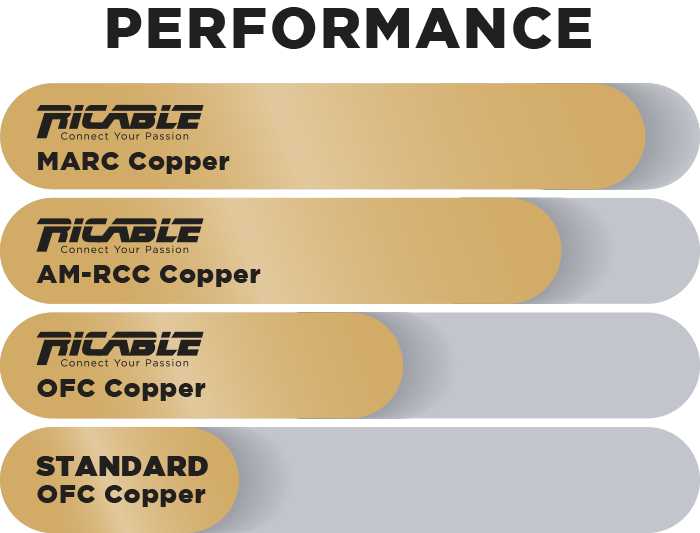
The third feature designed by Ricable to reduce the skin effect is the from RCCP connectors (Ricable Copper Connector Project). By using copper instead of brass in the connectors, the skin effect in the terminations is also reduced. Finally, the studies carried out and the research activity, gave birth to the new conductor MARC©, acronym of Multicore Annealed Ricable Conductor, which characterizes the entire production. Primus, Magnus, Dedalus e Invictus.
The improvements made made it possible to produce a copper conductor with 7N (99.99999%) purity that is more malleable than its predecessor, due to the reduction of grains per meter by 25% compared to AM-RCC. This production implementation allowed strands to be produced that was smoother on the surface, more ductile and smaller in diameter.
We, as enthusiasts, have worked to find a solution to the skin effect that really satisfies us 100%. The differences between the cables in the entire production break down the skin effect in a unique way. Whatever your system needs, you can look through our cables Speaker .







Is it better to use a multi-wire or solid-core conductor?
Hi Mario, it depends on the type of application, but for Audio, in our studios, the multiwire is almost always the best performing solution.